Page 2 of 2
Posted: Fri Dec 02, 2005 7:32 pm
by Smudgeman
It is strange that Abby would have to go to such great lengths to get her "best Cape", but I can also see how space could be limited. In my last house, the closet space was minimal, and I stored my jackets, coats, slacks, etc in the extra bedroom. I am sure Andrew and Abby's closet was full of their clothes, her big dresses, his trousers and slacks, they probably needed more room. But then , so did Lizzie and Emma. I have an extra bedroom now that I store alot of extra stuff. Maybe the girls thought Abby should stay on her side of the house?
Posted: Sat Dec 03, 2005 2:25 am
by Kat
I have the impression that Andrew- or most men of his day who were *thrifty* did not have a large wardrobe. So I doubt he took up much room- he probably only had few pairs of shoes too.
Some of their stuff even was stored in the sitting room closet.
You'd think that it would be easier on everyone if they overflowed their wardrobes into the attic.
Therefore, it's my impression that Abby keeping her own things in the guest room, kept her foot in the door, so to speak.
Something we haven't thought of tho, could be that if Abby & Andrew had a spat, that Abby might sleep in the guestroom! That would give her more reason to keep some of her own stuff in there!

Posted: Sun Dec 04, 2005 2:57 pm
by Allen
FairhavenGuy @ Sat Nov 12, 2005 1:46 pm wrote:
As far as the alibi. . . Most law enforcement officials tend to be suspicious when the details of an alibi are too good. A normal person under ordinary circumstances is not going to pay attention to the number of the street car he is riding or the name of the conductor, etc.
While knowing that stuff may, in fact, prove he was on that street car at that time, it also shows that maybe he knew in advance he was going to have to prove he was on that street car at that time. Carefully building an alibi can imply guilty knowledge that (a) something bad had happened or (b) something bad was going to happen.
I've been thinking alot about this theory that Morse was carefully building an alibi, and that the fact that he knew the number of the street car and the name of the conductor could be used as proof to show this fact. What I'm wondering is, didn't these street cars have regular routes? For instance, I know that the number such and such bus is going to be stopping at a certain place at a certain time every day. Or the same way that the people who ride the subway know what number train they have to get on because they ride them often, be it to work or whatever. Didn't these street cars have regular routes that would mean the same numbered street car stopped at the same place every day? If they did, than it could stand to reason that it would be very easy for him to remember, or check, what number street car he rode that day. As for knowing the name of the conductor, if he rode the street car before, he may have known it. I knew the name of my bus driver in school.
Posted: Sun Dec 04, 2005 7:25 pm
by nbcatlover
Fairhaven Guy--All I can offer is 7 years commuting by bus to Boston. Took the bus at the same time each day, but it was not the same number bus each day.
Certain bus drivers wouldn't drive certain busses. There were different seat configurations, so they might send out a bus with 43 seats for an anticipated slow day while they might send out a 50 seater for a day they expected to be busy.
The trolley cars went in the car barn every night. Who's to say what order they got pulled out and placed on the tracks? It might depend on who got there first and what horses they used. I'm not sure you could predict that Trolley #11 comes by at 11am and Trolley #12 comes by at 12noon.
My father used to tell me stories of people putting stuff on the trolley tracks to flatten things out, and they sometimes derailed the cars. Then they'd have to wait for some guy to come with a horse and pull it back on the track.
I, too, have found the detail of Morse's alibi suspicious, but on the other hand, he was known as a sporting man in his youth. My uncle was a gambler and could tell you that taxi number 2 ran a stop sign and bus #12 was late, because as a gambler, he was completely in tune to the numbers on everything. Morse could be like my uncle--notice the numbers to play the penny pools, but not the people in front of the house where murder was committed.
Posted: Mon Dec 05, 2005 3:30 am
by Kat
Andrew I think was the man considered by some to be a *sporting man* in his youth. (Does that always mean a gambler? I suppose it's possible...)

Attny. Phillips is the only person who claimed Morse knew the conductor's cap number..but no one claimed Morse knew his name.
Phillips' page 3 download at website:
"Although Mr. Morse was first suspected of the crime, he presented the most complete and remarkable alibi ever known, and was almost immediately eliminated from police inquiry. After leaving the Borden home early in the morning, Morse had taken a street car to Weybosset Street from the center of the city and was there till both murders had been discovered. He furnished the police with the number on the conductor's cap and the names of persons he had seen or met. To a certainty he was not in the Borden house when the murders were committed, but nevertheless he had to have a police guard to protect him from infuriated mobs."
The newspapers said that they found out one of the conductors they needed to question was a substitute. It was 6 priests seen that day on the car which everyone remembered.
Posted: Mon Dec 05, 2005 2:33 pm
by Allen
Well I was interested in whether or not the street cars had regular routes, and once I get interested in something there isn't anything to do but do some research or I won't be happy

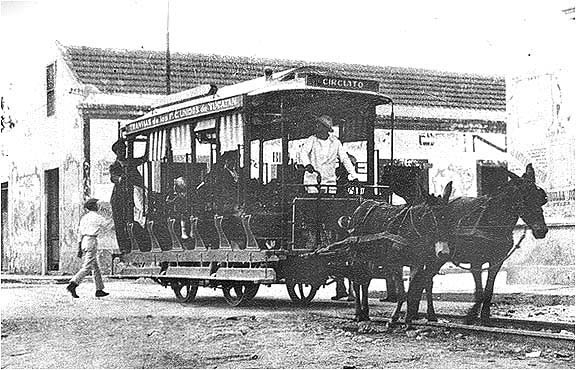
. I don't know what this will have to do with Morse's alibi, if anything, but it does seem that street cars had regular routes where the same number car took the same route. In most of the pictures of horsecars they have the numbers of the car, and the name of the route it travels right on the car. It also seems that the same conductors did work on the same cars.
Much like the ones in these pictures of 1890's horse drawn street cars, or "horsecars".
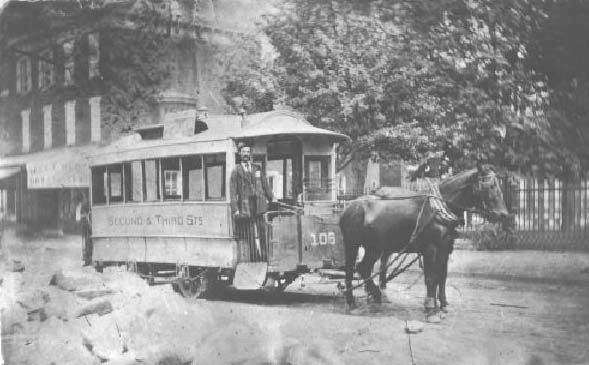
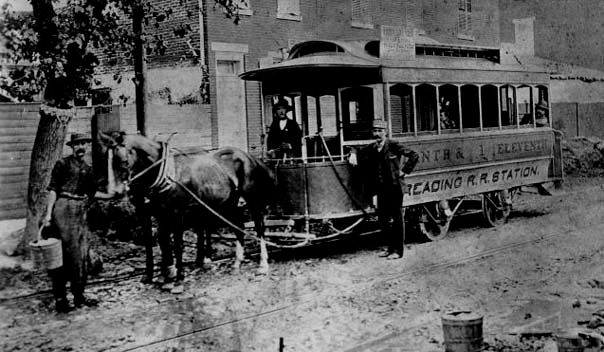
Some other interesting pictures I found:
http://www.tramz.com/br/rj/st/hc.html
http://www.trolleystop.com/cablecar.htm
http://www.tramz.com/mx/yu/yu11.jpg
http://freepages.history.rootsweb.com/~ ... hotos.html
Posted: Mon Dec 05, 2005 2:49 pm
by Allen
The conductor was also not always the one who necessarily operated the horsecar, he usually was the one who walked along the car collecting fairs.
Posted: Mon Jan 02, 2006 2:25 pm
by john
Wow! I wish you would have been my editor when I was publisher of that boring magazine.
Posted: Mon Jan 02, 2006 2:33 pm
by john
Perhaps Morse always did this, note the conductors caps, etc. Did anyone ever try to figure that out?
Perhaps that was an idiosynchracity (sp?) of his. Wrong tense I think, oh well. Beware of the man who knows how to spell, because, as the Kingfish said to Andy, "I is the Broker, and you is the Brokee!"