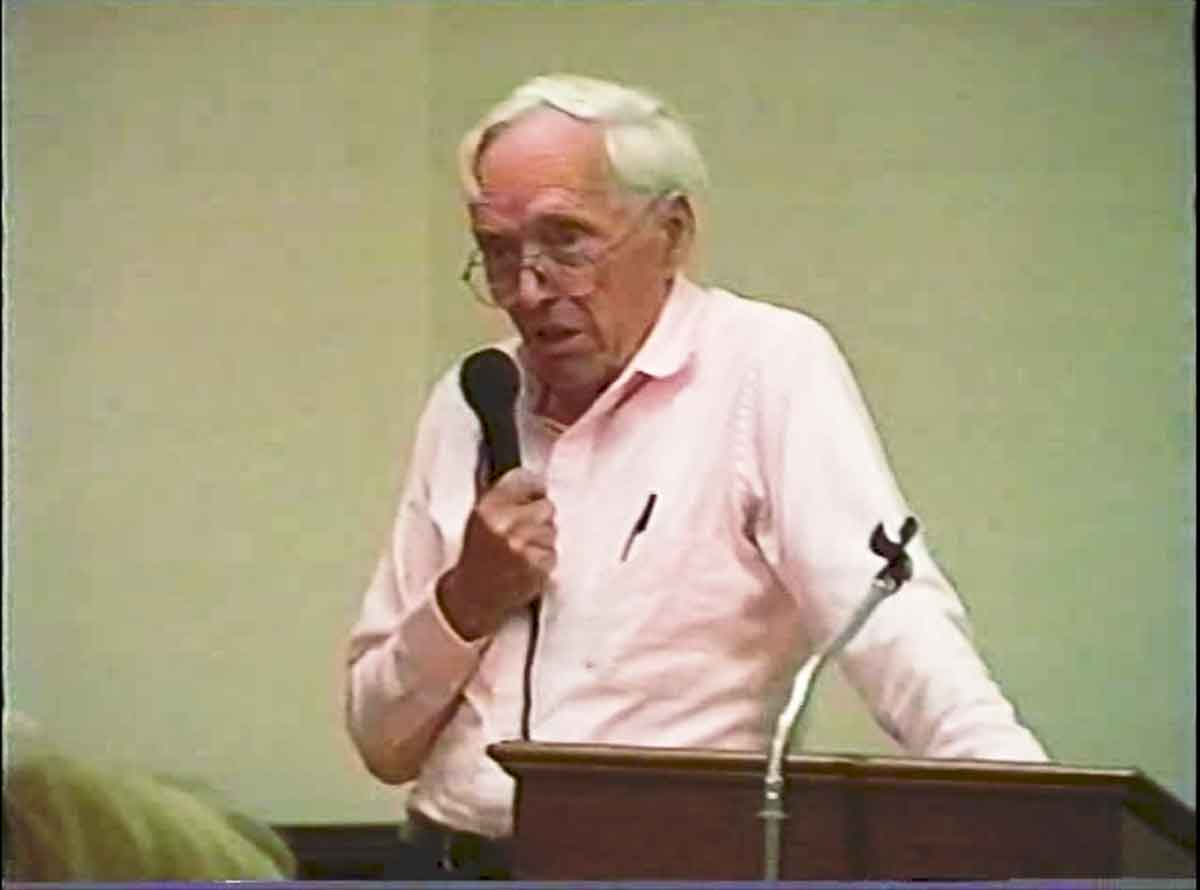
I heard a rumor that William Masterton, author of Lizzie Didn’t Do It! had passed away last year but I couldn’t confirm it until now. I was pointed to this post on a FreeList site that tells the sad news and the details of the condition that lead to his death. Using my resources, I was not able to locate an newspaper obituary in either Connecticut or Massachusetts. If anyone does have this info or a copy of the obit I would appreciate it. You could send it to me by email.

It is with overwhelming sadness that I report the recent death of Dr. William L. Masterton, Emeritus Professor of Chemistry at the University of Connecticut, Storrs.
Many of you may have used various editions of his (and co-authors’) best selling high school or college general chemistry textbooks and/or problem and lab manuals. He also ventured forth into the realm of forensic science/history with his published and very highly rated book, “Lizzie Didn’t Do It,” about the famous Lizzie Borden case that took place in the 1890s in Fall River, MA.
I can attest through first-hand experience that, not only was Bill a great lecturer in general chemistry, but his two graduate thermodynamics courses were superb.
After suffering a massive stroke while at dinner in Conway, NH, on June 16, CPR was administered without success. He was then airlifted to a hospital in Maine. His wife, Loris, two sons, and a grandson made it to his bedside from Storrs, Germany, and Pennsylvania. Bill died while still in a coma at 4 am on June 19 (ironically, Father’s Day).
Bill’s funeral and burial will be held in Conway this Thursday, June 23. A memorial service is planned for later in the year, most probably at UConn. I will provide the date, time, and location via e-mail before then so you can attend.
Sorry about the very sad news.
Laddie
Ladislav H. Berka, Ph.D.
Research Professor of Chemistry
Department of Chemistry
Worcester Polytechnic Institute
 Masterton’s book was positively reviewed by The Lizzie Borden Quarterly. He also wrote many pieces over the yearsfor the now defunct Quarterly. To read about his articles and Letters to the Editor please visit the LBQ Bibliography.
Here is brief review of his writings for the LBQ:
- “Thousands of Solutions to the Borden Mystery Lost Forever.” Lizzie Borden Quarterly III.4 (October 1996): 18.
Half-page essay in which Masterton reports that more than 60,000 entries to a contest conducted by Liberty magazine in 1929 to solve ten unsolved murders, including the Borden case, were received but discarded. - “Weather We Do: Some Like It Hot!” Lizzie Borden Quarterly IV.1 (January 1997): 7-8. After quoting various authors on the Lizzie Borden case that all claim that the day of the murders was a very hot one, Masterton uses three sources (the Fall River Daily Herald, the Fall River Evening News, and the United States Signal Service) to prove that the temperature was not over 78 degrees when Andrew was murdered.
- “Washing the Handleless Hatchet.” Lizzie Borden Quarterly V.3 (July 1998): 3. Masterton disputes oft-repeated claims that when Professor Wood was testifying at the trial in regards to the murder weapon and whether blood could have been washed from its surface so it could not be detected, he was not, in fact, speaking of the famous handleless hatchet, but was testifying about a claw-hammer hatchet which had been eliminated as a murder weapon.
- “The Robinson File; What’s In It?” Lizzie Borden Quarterly VI.2 (April 1999): 6, 22. Masterton postulates about the contents of the Robinson files.
- “Improper Conduct by Judge Blaisdell? Jennings vs. Blaisdell.” Lizzie Borden Quarterly VII.1 (Jan. 2001): 1, 22-23. Masterton accuses Judge Blaisdell of being “legally within his rights” to refuse to recuse himself from presiding over the Preliminary Hearing after presiding over the Inquest, but that he was “ethically guilty of what was at best a conflict of interest and at worst bribery.” Of note is Masterton’s detailing of the consequences of Blaisdell’s behavior in this and other cases, finding that the executive council was on the verge of submitting their recommendation to the Fall River Bar Association on Blaisdell when he unexpectedly resigned citing failing health, effectively ending the investigation into his actions. Included also is the resignation correspondence between Blaisdell and the executive council as well as excerpts from the Fall River Herald (March 16-April 13, 1893) regarding the topic.